
Automatic Extraction of Radio Comms to Marple Using Agentic Coding
Whether it’s an F1 race, a SpaceX launch, or the latest test of an eVTOL aircraft, radio communications is always a big part of it. Constantly, back-and-forth interaction is happening between drivers or pilots, engineers and safety responsibles. On TV, you often see snippets like this:
.png)
If you want to jump straight to the demo, view this YouTube video or go to speech.marpledata.com.
Radio comms are everywhere!
Whether it’s an F1 race, a SpaceX launch, or the latest test of an eVTOL aircraft, radio communications is always a big part of it. Constantly, back-and-forth interaction is happening between drivers or pilots, engineers and safety responsibles. On TV, you often see snippets like this:
.png)
From an engineering point of view, the recorded audio is a gold mine of information if it can be correlated with the time series data.
Usually, the recordings just end up as raw files .wav, .mp3, .m4a on a network drive. A lot of our users keep a media player open to listen to the audio while investigating in Marple Insight:
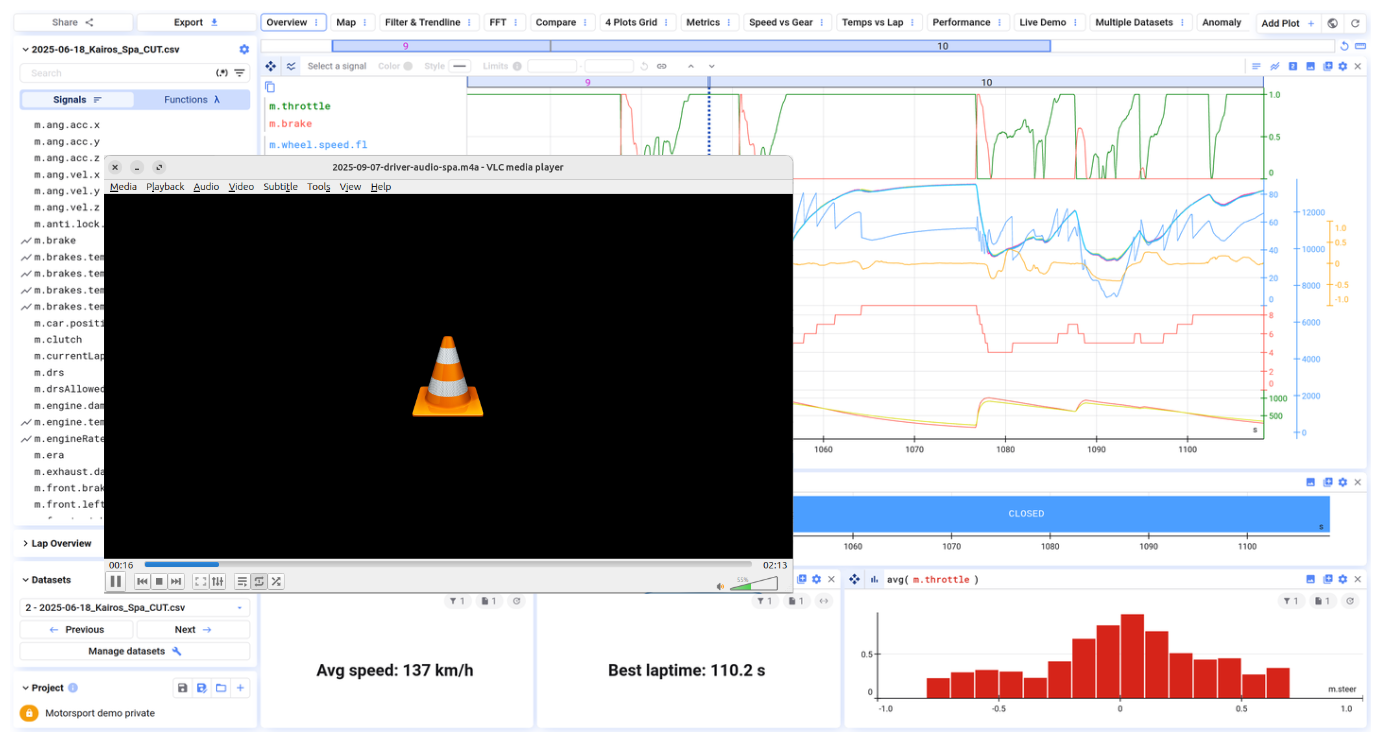
There’s a better way! In this blog post we share an AI-assisted workflow that automatically converts the radio communication to readable Text Annotations, overlaying them straight on top of the time series data in Marple Insight:
.png)
The ideal speech workflow
The ideal workflow shows the recorded speech data directly overlayed on time series graphs as text. The time series data can be handled out of the box with Marple DB and Marple Insight. The only missing part is a way to transform audio files into text, outlined in red below:
.png)
Speech decoding used to be a hard problem. But since the release of Whisper by OpenAI in 2022, the quality of open-source tooling has skyrocketed. For this demo, we will use the python package faster-whisper, a lightweight implementation that can run with as little as 1 GB RAM.
Executing the above design should take a decent software engineer no more than a couple of days, and some extra time to deploy the software on a server.
But why not give it a try with agentic coding?
Let Agents + Marple do the work for you
Our design has three hard parts, solved by leveraging high quality pieces of software for these dedicated tasks. These essential building blocks are performance-critical, sensitive for security. It’s impossible to solve these parts with the current state of AI:
We are using these building blocks to do the heavy lifting for us. Each of blocks has a clean interface to interact with it through code. For Marple, the Python SDK provides all necessary functions to integrate.
All that is left is easy code to wire it together. And easy software has become a commodity.
Briefing AI with a plan
Writing agentic code works best if you write a detailed plan. The full plan we wrote for this application is available here. The key information boils down to these three sections:
(1) Speech decoding
To keep speech decoding light on resources, use faster-whisper with:
* device="cpu"
* compute_type="int8"
* model="tiny" (or "base" at most)
(2) Marple DB
You can leverage the Marple Python SDK to talk to Marple products (and it’s APIs):
* https://pypi.org/project/marpledata/
* https://marpledata.gitlab.io/marple-sdk/

Use [Marple] DB to fetch a nice list of all available datasets
(3) Marple Insight
These are the relevant features from the Marple Insight API that you can call through our SDK:.png)
The plan was further refined by letting Claude Code ask questions. This resulted in the section Decisions & Clarifications at the bottom of the plan document.
Result: Speech2Marple
Executing the plan took the agent 10 minutes, and after 20 more minutes of debugging, we had a fully functioning web application called “Speech2Marple”. This 2-minute demo video shows how it decodes the radio comms from a Formula 1 driver perfectly and overlays it on the time series data:
We used Claude Code, but alternatives like Cursor and Codex should give similar results. In total, we spent less than one euro on AI credits to implement and debug the whole application.
One of our customers (a hypercar company) implemented a similar flow, but without a user interface. It runs continuously on a server, with more or less this flow:
- Python notebooks to run the code
- Periodically check the network drive for new
YYYY-DD-MM-hh:mm*.wavfiles - Similar
whisperdecoding as our approach - Decode the timestamp from the
.wavfilename and correlate with the available datasets in Marple DB usingdb.get_datasets()(see docs)
You can do this yourself
In this writeup, we showed how agentic coding is extremely powerful when combined with high-performance tools like Whisper and Marple DB. In total, we spent 1h30 from writing the plan to a fully functioning application. Writing this blog post took longer!
Getting started with this is not hard at all. Our documentation on Agentic Coding with Marple is a good place to start. A typical approach goes like this:
- Write a plan about what you want to achieve (example)
- Add prompting snippets from our Agentic Coding documentation
- Review the plan with your agent
- Execute!
If you build something cool with AI + Marple, please share it with us through dev@marpledata.com or the usual channels. We are always excited to see what workflows people are building on top of Marple!
Interested in trying Marple? Don’t hesitate to book a demo.
