How AeroDelft accelerates liquid hydrogen flight testing with data-driven validation
AeroDelft needed a more powerful and standardised way to work with the data of their hydrogen-powered aircraft. By integrating Marple Insight and Marple DB into their test workflow, the team now analyses flight data in real time, automates requirement validation, and streamlines communication between engineering and flight testing.

Aerospace
AeroDelft is pioneering the use of liquid hydrogen as an alternative to conventional aviation fuels. Their mission: to prove and promote hydrogen as a sustainable alternative to conventional fuels in aviation. To achieve this, they are designing and testing their own hydrogen-powered aircraft, starting with gaseous hydrogen and transitioning to liquid hydrogen integration in the coming year.
With ambitious timelines and complex qualification requirements, AeroDelft relies heavily on data-driven processes. To manage this complexity efficiently, the team turned to Marple.
This case study explores how AeroDelft uses Marple to increase testing velocity, automate requirement validation, and streamline communication between engineering and flight test teams.
The challenge
AeroDelft’s engineering and flight testing teams manage a large volume of collected sensor data. They have a fast design cycle, where they are validating a part of the technology with each iteration:
- Systems engineering and requirement definition
- Writing detailed test plans (both on test rigs and flight testing)
- Executing extensive test campaigns, collecting the necessary data
- Validating that system behaviour matches safety and performance requirements
Hydrogen propulsion adds additional complexity, with systems operating at cryogenic temperatures and requiring stringent qualification documentation for aviation authorities. The team uses testing data to demonstrate that their system is safe and performs as intended, making data integrity, traceability, and efficiency essential to obtain a permit to fly.
AeroDelft identified these key challenges before using Marple:
1. Managing massive test datasets
Each test campaign produces large quantities of sensor and system data. In the case of AeroDelft, this is collected two formats:
- CSV, using a custom defined format for data from test rigs that contains both data and metadata
- Chapter 10 files (.c10), collected with IADS, containing timestamped telemetry data from onboard data acquisition systems
Both file types contain data at high frequencies, and during active test campaigns tens of files can be logged on a single day. It's hard to make data at this scale available to the whole team in a standardised way.
2. Manual requirement validation
Prior workflows required engineers to write MATLAB scripts to inspect test results, even for making time series visualisations. This meant that engineers had to perform many manual actions to be able to validate the requirements. This slowed down the testing cycle, and delayed the feedback required by design engineers as well as authorities.
3. Limited real-time collaboration
Test execution is happening mainly off-site, in testing facilities where safety can be properly controlled. This meant that office-based engineers couldn’t support test engineers during test execution, making iterative testing less efficient because data analysis happened after returning from test sites.
Solution: Integrating Marple into the test engineering workflow
To relate the test data to the requirements and validate the system, AeroDelft integrated Marple Insight and Marple DB into its test planning, data analysis, and reporting pipeline.
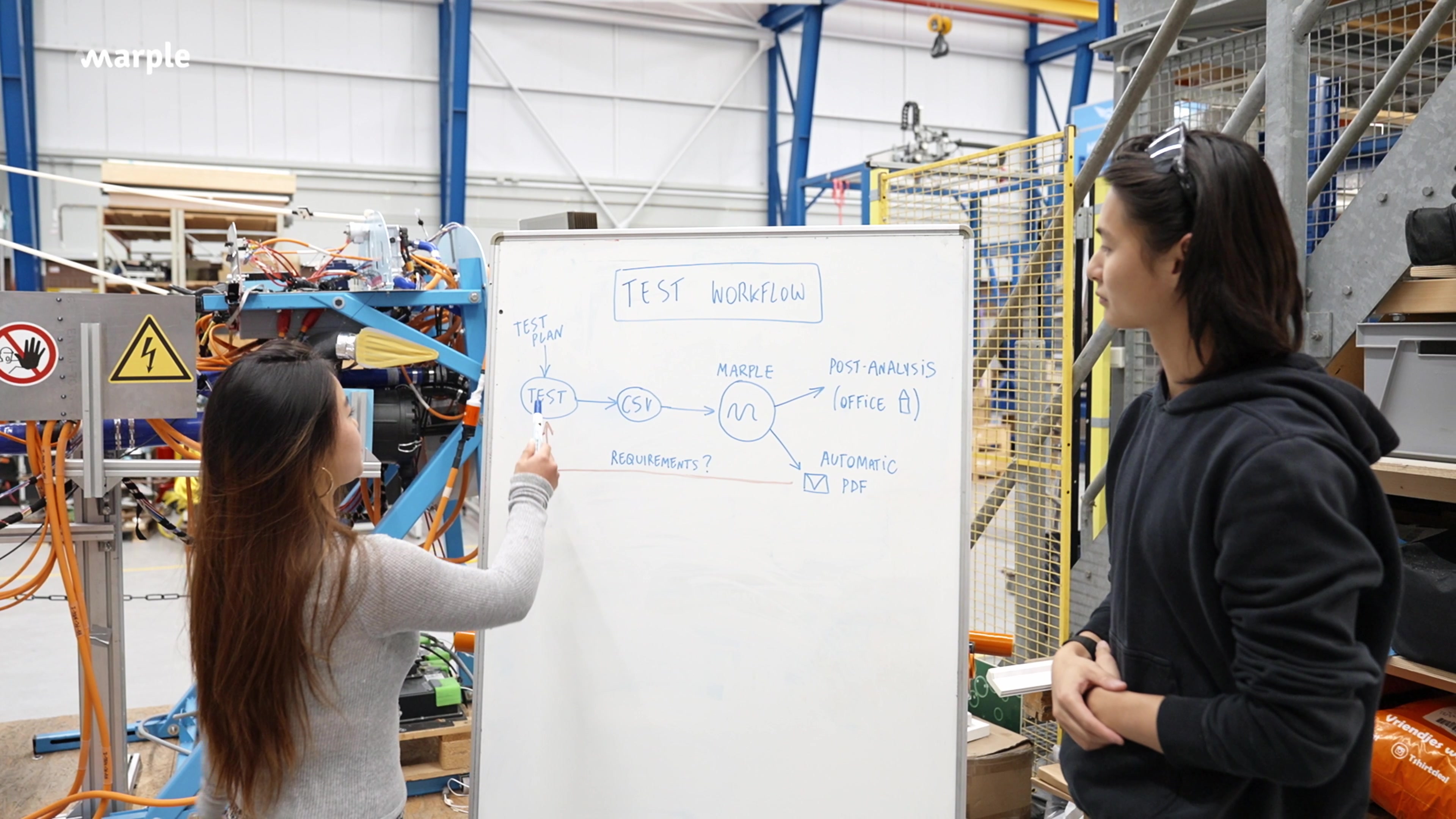
Step 1: Testing
With Marple DB's realtime module, AeroDelft can already look into the test data while it's still running. While tests are being performed on-site, colleagues in the office can immediately start reviewing incoming data and flagging issues.
Step 2: Data import
After each test, Aerodelft’s test engineers import the full high-frequency log into Marple DB. They are both importing CSV and IADS data, using two datastreams to separate the data flows. With signal aliases, they are unifying the channel names across these two data flows, resulting in a standardised naming convention across the whole data storage.
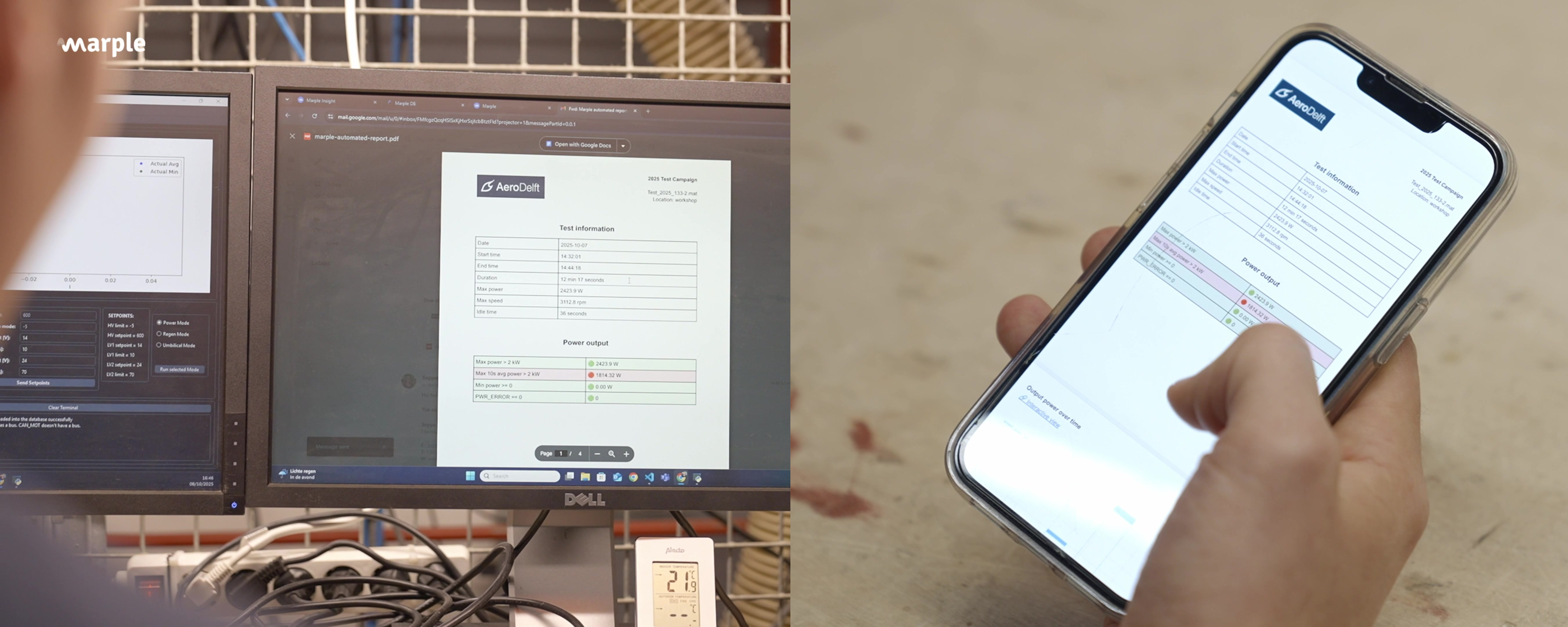
Step 3: Automatic validation
Using Marple DB's MATLAB SDK, AeroDelft automatically validates requirements instead of manually scanning through logs. They also set up Marple Insight's reporting feature, to automatically generate reports based on thresholds for key parameters in their systems. This allows them to instantly validate if safety requirements have been met, or if further investigation is required.
Step 4: Campaign overview
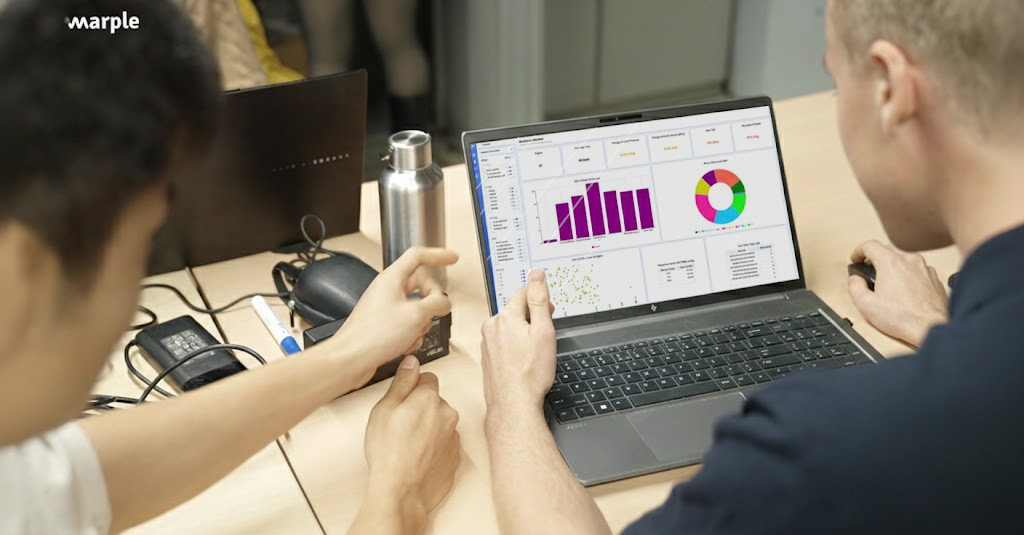
AeroDelft uses Marple’s overview dashboards to manage the progress of a complete test campaign. It allows them to see in one view what test conditions have been covered across all tests. This allows the team to see at a glance whether the available test data is sufficient or if additional extensive testing is required. Outliers can also be spotted easily, and can be investigated by drilling down into the time series data.
What’s next?
In the future, AeroDelft is looking to deepen its use of Marple by integrating its requirement management software using Marple Insights' dynamic share links. This will allow validated test results to flow automatically back into the requirements management software, providing immediate, traceable evidence that systems meet the criteria set by flight authorities.
AeroDelft also intends to leverage Marple DB to bring simulation data and test data together in a single environment. By streaming both sources into one database and comparing them in Marple Insight, the team will be able to close the loop between model and reality more efficiently, improving confidence in their models and supporting future certification efforts.
Over the next decade, AeroDelft expects aerospace engineering to become even more data-driven, with higher data volumes, higher sampling rates, and increasingly complex sensor setups. In that context, AI-assisted analysis will likely become essential: automatically scanning large datasets, spotting anomalies, and predicting failures early so that issues can be prevented rather than detected after the fact. Having their data already standardised and unified in Marple DB will enable them to take these steps in the coming years.